Recent advances in neuroscience and artificial intelligence now make a neolab focused on the intersection of both commercially viable.
Eight results from other labs, two papers of our own.
Recent Related Research
- 1Big Brain Lab, October 21, 2026
Proofreading accuracy rises with data and has not leveled off
Human correction of the computer's tracing is where the cost is. We fine-tuned a 7 million parameter image model, a ConvNeXt-Atto starting from ImageNet weights, on the public benchmark of proofreading decisions, built from the logged corrections of the fly and mouse maps. On ConnectomeBench2's full 101,929-decision held-out split it scores 97.4 percent on split correction and 94.4 on merge identification, against the benchmark's own model at 97.0 and 93.0 and its human-expert point estimates of 93.0 and 84.1; the split score sits inside the experts' interval of 87.2 to 97.7. Its error falls as a power law in training data, with exponents of 0.20 and 0.16, and has not leveled off. On 400 of the held-out decisions it is also more accurate than four frontier language models at maximum effort, 97.0 and 95.5 against their best of 89.0 and 72.0, and more than ten thousand times faster per decision. Scoring decisions on a benchmark is not finishing a brain, and anyone can rescore it. The paper (PDF).
Balanced accuracy against the number of training decisions, three seeds per point: the sweep points on ConnectomeBench2's 23,730-decision subset, the all-data point on the full 101,929-decision split. Dashed lines: the benchmark's published human-expert point estimates. Diamonds: the benchmark authors' own model, trained on all 716,485 decisions. Below: balanced accuracy per task and time per decision on 400 held-out decisions, 200 per task, four species, as bars. Ours is the same model, ConvNeXt-Atto with 6.9 million parameters fine-tuned from ImageNet-pretrained weights, timed as batched throughput on one H100; the frontier models are timed as the median API call at their maximum effort setting, measured September 29, 2026. Colors follow the rule in the legend: green at or above the benchmark's published human-expert estimate, yellow within ten points below it, red further below; for time, green under a second, yellow under a minute, red a minute or more. A 56 million parameter ConvNeXt-T started from DINOv3 weights scored 98.5 and 96.0 on the same decisions. - 2Big Brain Lab, October 17, 2026
Agents reading a mapped brain beat the raw simulation, and about half the gain is the map
We ran the Goodfire playbook on the one brain that already exists as a complete model, the Shiu et al. 2024 simulation on the FlyWire connectome, every neuron of which can be driven or silenced in software. Agents with the wiring and the simulator investigated 259 published activation and silencing experiments from 24 papers and predicted each result: 0.90 AUROC against the raw simulation's 0.83, a gain of +0.07 with a 95 percent interval of +0.02 to +0.12, above the pre-registered +0.05 bar. Then we hid every neuron name behind an opaque code so the agent could read the wiring but not recognize the paper: the gain fell to +0.04 overall and held at +0.09 on the 90 experiments the model's authors had not used to build it. That +0.09 is what the map and the model add on their own; the rest was the language model's memory of the literature. Frozen before the first run, two replicates per arm, and written up as a manuscript; not yet published. The paper (PDF); Shiu et al., Nature 2024 (the model).
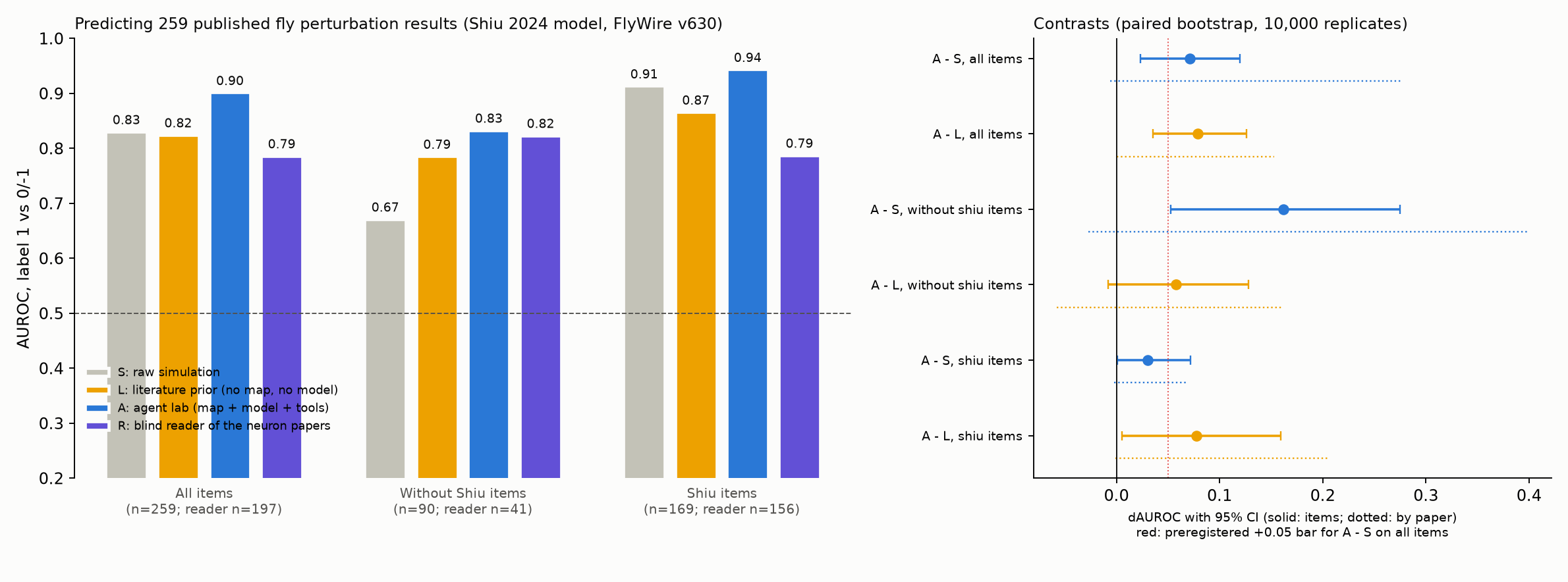
The fly test's headline numbers, our figure. AUROC for predicting whether a published activation experiment produced a response, 259 experiments from 24 papers on the Shiu 2024 fly model. Gray: the raw simulation. Orange: a language model given only the names, with no map and no model. Blue: the agent with the wiring and the simulator. Purple: a fresh agent reading only the neuron papers. Right: the contrasts with 95 percent intervals by experiment (solid) and by paper (dotted); the red line is the pre-registered +0.05 bar. Run on October 16 and 17, 2026; the manuscript above holds every number. Not yet published. - 3Goodfire, October 15, 2026
Agents that read a complete network, neuron by neuron
Nick Cammarata's essay Neural Networks Are Already Clean reports what happens when every neuron of a network can be read, every one can be removed, and automated scientists run the experiments: the network turns out to be organized rather than knotted. In its audits of Qwen3-32B about 90 percent of neuron poles (each neuron has two) have one main job, 7 percent two related ones, and 2 to 4 percent are not yet understood. It is an informal essay and working hypothesis about artificial networks, and the author says so. Whether it transfers to a biological brain is an open question. Cammarata, Neural Networks Are Already Clean, Goodfire, 2026.
Illustrative proportions from the Qwen3-32B audit, drawn as one hundred units: roughly 90 percent of neuron poles with one job, about 7 percent with two related jobs, 2 to 4 percent not yet understood. The essay's own figures, approximate. - 4Cell, September 3, 2026
A complete male fly nervous system, compared with the female's
Berg, Beckett, Costa, Schlegel and colleagues, with Gregory Jefferis, released the connectome of the entire male Drosophila central nervous system: 166,700 neurons across the brain and nerve cord, fully proofread and annotated into 11,710 types, with the sex-determining transcription factors marked. It is the first comparison of a male and a female brain at synaptic resolution: 8,069 neuron types are the same in both, 138 differ, 289 exist only in males and 71 only in females, and the differences concentrate in the higher brain centers while the sensory and motor periphery is shared. Two complete maps of one species are what you need to ask which wiring differences produce which behaviors. Berg et al., Cell 2026.
Neuron types in the male and female fly, as the paper counts them: shared, dimorphic, male-only and female-only. Drawing from the paper's numbers. - 5arXiv, February 4, 2026
An AI that discovers mechanistic models of neural activity, tested on a simulated zebrafish
Lueckmann, Jain and Januszewski at Google built a test bed where the ground truth is known: a neuromechanical simulation of a larval zebrafish. An LLM-driven tree search discovered predictive models of its neural activity on its own and beat the standard forecasting baselines. Two lessons carry to real recordings. Conditioning on the sensory drive is necessary but not sufficient, because models find statistical shortcuts; and structural priors are what make the recovered models interpretable and robust outside the training distribution. The authors offer it as a template for AI-driven discovery on real brains. Lueckmann, Jain and Januszewski, arXiv 2602.04492.
A simulated larval zebrafish supplies activity with a known ground truth; a tree search driven by a language model proposes models and keeps the ones that predict it. Drawing after the paper's framing. - 6bioRxiv, September 28, 2025
Cells that label themselves
E11 Bio's protein barcodes give each neuron a combination of tags that the tracer can read, so a wrongly joined pair of cells announces itself. Shown at fivefold expansion on a hundredth of a cubic millimeter. Whether barcodes work at sixteen-fold, and how much they add once the tracing is good, are two of the first things we want to measure, with E11's data. Park, Sheridan, An et al., bioRxiv 2025; E11 Bio, PRISM.
Two cells, two barcodes. Where the tags change mid-trace, the tracer has joined the wrong pieces. Drawing. - 7eLife, June 30, 2025
A whole expanded brain imaged in a day
ExA-SPIM, from the Allen Institute, images a whole mouse brain in about 24 hours on a light-sheet microscope at three-fold expansion: enough to follow the long projections of sparsely labeled cells, not yet enough for synapses, whose clefts are about 20 nanometers wide. The optics and the sample handling for whole expanded brains exist. The sixteen-fold version is the microscope that still has to be built. Glaser, Chandrashekar et al., eLife 2025.
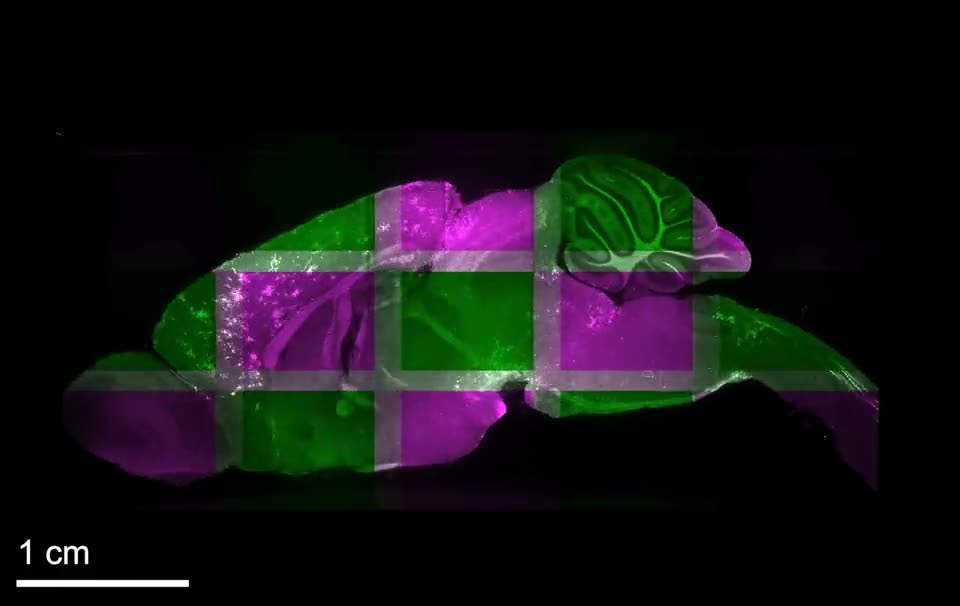
The Allen Institute's light-sheet microscope imaging a whole expanded mouse brain tile by tile; the brain itself is in the Mapping section above. Glaser et al., Video 1, CC BY 4.0. - 8bioRxiv, May 21, 2025
Tracing that repairs its own mistakes
PATHFINDER, the reconstruction pipeline from Google and Janelia, adds two models that propose and check repairs to the automatic trace. On a 676,000 cubic micrometer block of mouse cortex it raised the normalized expected run length of its axon traces from 82 percent to 94 percent (Table 1 of the preprint), which its authors put at 84 times the optimistic proofreading rate in the Wellcome-commissioned 2023 report. The errors that remain are what human proofreaders fix today. Januszewski et al., bioRxiv 2025.
The two kinds of mistake a tracer makes, a break and a wrong join, flagged and repaired. Drawing. - 9Nature, May 7, 2025
A wiring diagram from a light microscope
LICONN, from Johann Danzl's lab at IST Austria with Google, expanded mouse cortex sixteen-fold in a hydrogel and imaged it on an ordinary spinning-disk confocal at an effective voxel of 10 x 10 x 25 nanometers. The automated tracing reached an accuracy its authors call comparable to electron microscopy's, with the synapses and the cell-type proteins labeled in the same gel. Until this paper a dense wiring diagram needed an electron microscope. Tavakoli, Lyudchik, Januszewski et al., Nature 2025.
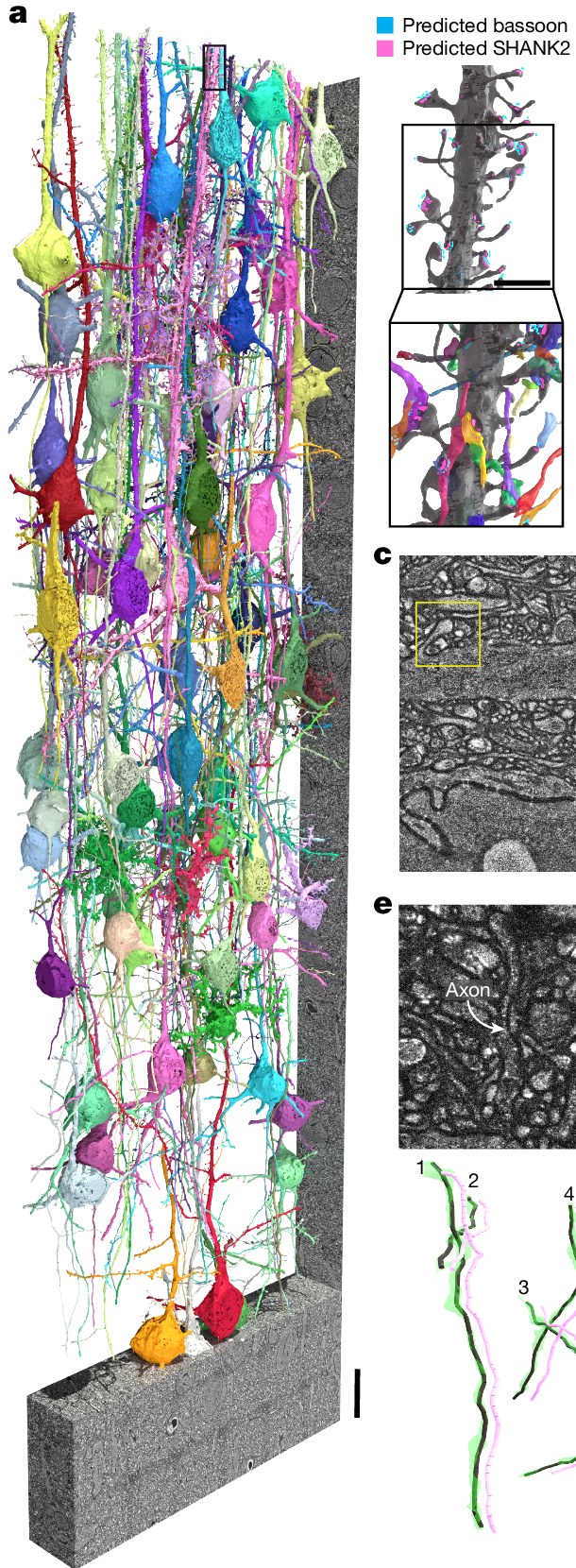
A column of mouse somatosensory cortex, 396 x 109 x 22 µm, imaged with light after sixteen-fold expansion, with 79 of its cells traced automatically. Tavakoli et al., Figure 1a, CC BY 4.0. - 10Nature, October 2, 2024
A complete wiring diagram of an adult brain
FlyWire, led by Sebastian Seung and Mala Murthy at Princeton with hundreds of collaborators, released the full connectome of an adult female fruit fly: about 140,000 neurons and 50 million synapses, traced from electron microscopy and proofread by a community of scientists and volunteers. It is the first complete wiring diagram of an animal that walks, flies and learns, and the first one big enough to test whether a map predicts behavior. Our own reading of it is the drawing beside. Dorkenwald et al., Nature 2024; Gordon and Scott, Neuron 2009.
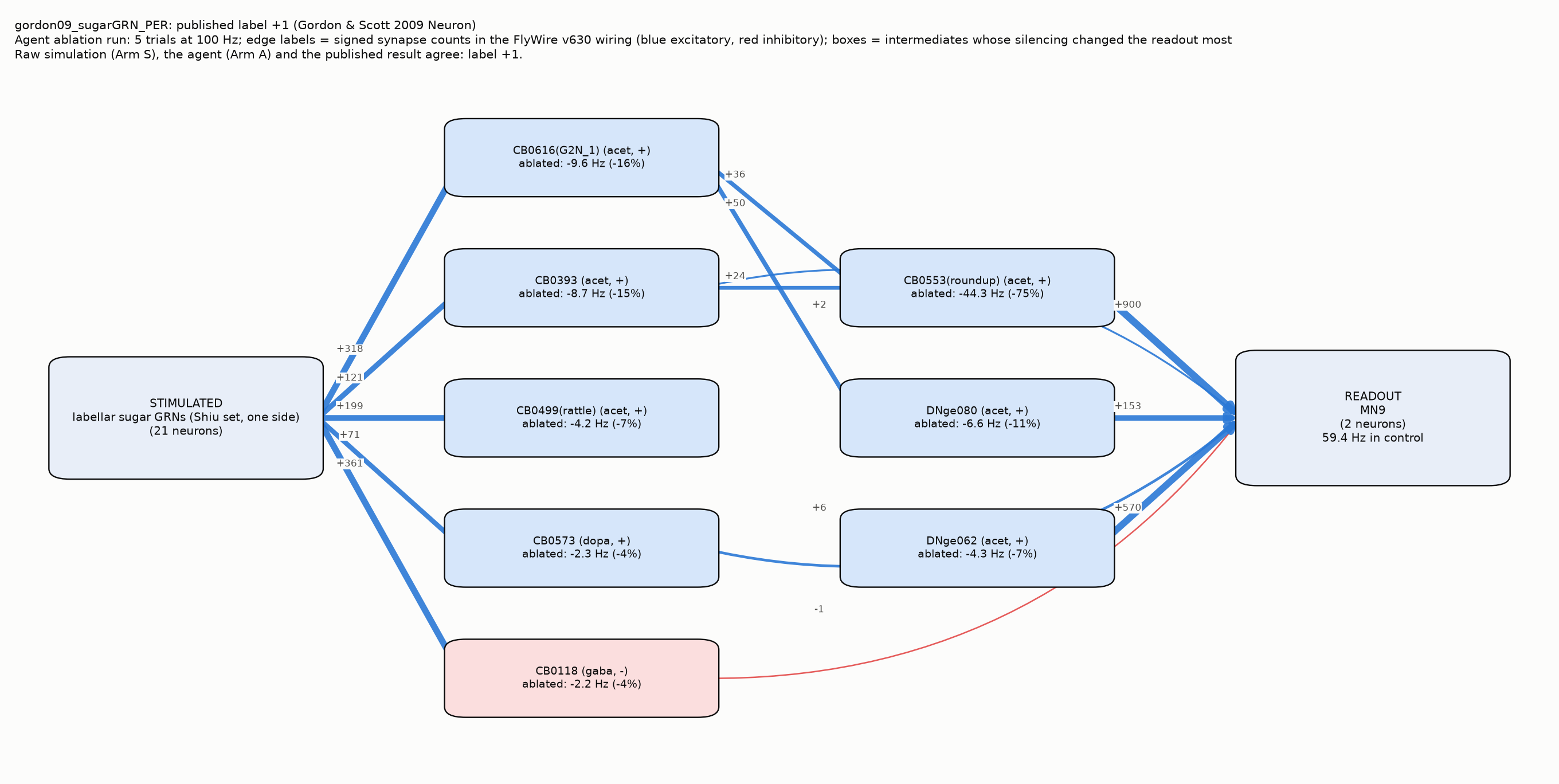
A path we traced through the FlyWire map: from the sugar-sensing neurons to the motor neuron that extends the proboscis, with synapse counts from the map and the effect of removing each neuron in our simulation (our manuscript, above, not yet published). The experiment it reproduces is Gordon and Scott, Neuron 2009. Our figure, from the FlyWire data.